
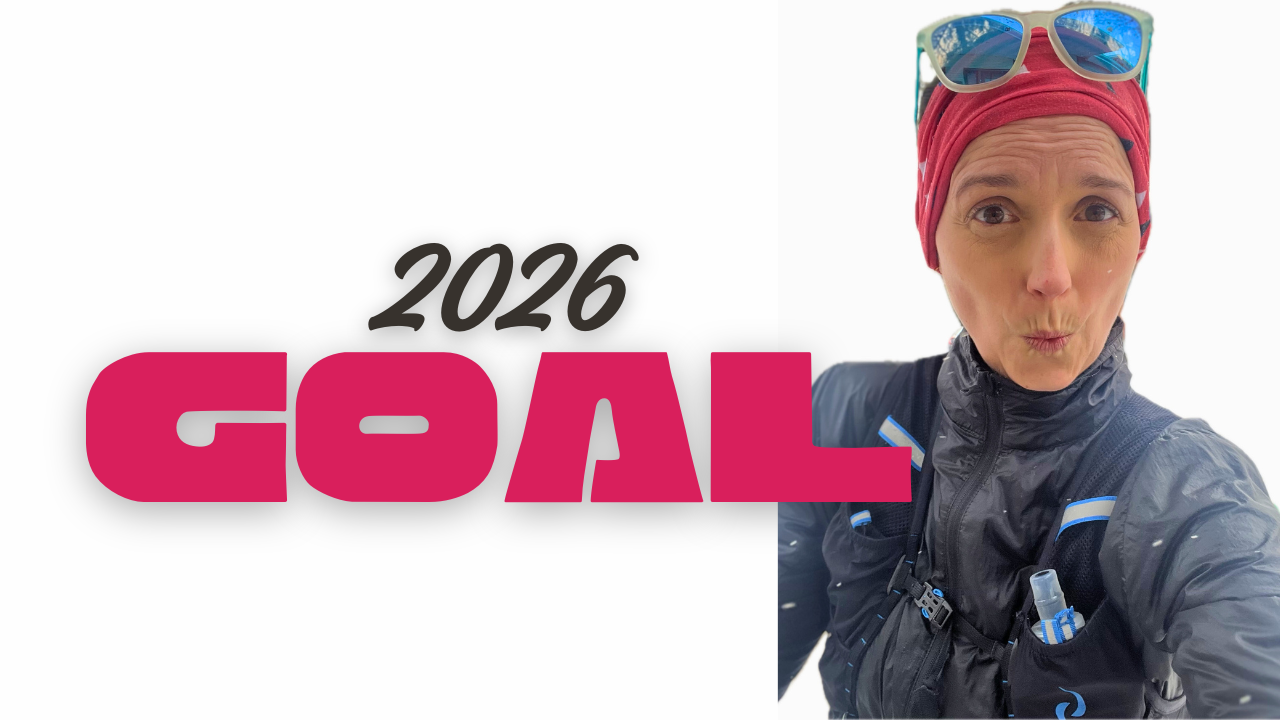
6 Things I’m Looking Forward to by Not Training for an Ultra Marathon in 2026
Dec 31, 2025This might surprise you, especially if you’ve been following my running journey over the last few years, but here it is:
I’m not training for an ultra marathon in 2026.
Instead, my big objective is a road marathon.
And this decision feels less like stepping back… and more like stepping into the kind of runner (and human) I want to be right now.
If you’re a beginner runner, an inconsistent runner, or someone who feels like running goals always have to get bigger, harder, and more impressive to count; I hope you'll relate to some of the 6 elements I talk about below and maybe they will spark your own 2026 reflection.
Because choosing not to do the hardest thing available can sometimes be the most growth-filled decision of all. Or at least, this is my hope stepping into 2026.
A Quick Look Back: When the Goal Started to Feel Heavy
In 2025, my big running goal was my second ultra. A 55K trail race, to be exact.
Ultra training is no joke. It means long hours on your feet, complex planning, and a lot of mental energy. Somewhere along the way, I started feeling what I now recognize as training fatigue. It was not just physically, but actually mental fatigue.
The 55km goal slowly became… bigger than it needed to be.
Toward the end of the summer, I found myself stuck in a constant internal debate:
-
Do I push through and do the 55K?
-
Or do I drop down to the 25K and actually enjoy the experience?
I really struggled and went back and forth for weeks. My head and my body were constantly disagreeing about what to do.
In the end, I chose the 25K.
Not because I couldn’t do the 55K, but because I realized I had nothing to prove. I wasn’t doing this to win. I was doing it because I love running. And I wanted the challenge to be about having fun in the process, not surviving it.
That decision quietly changed how I started thinking about 2026.
1. Choosing What Excites Me Now, Not What Impressed Me Before
For the last two to three years, trail running has been my world.
Before that? Roads.
When I first started running as an adult, it was always on pavement. It’s only recently that I shifted almost entirely to trails. Roads were a little like my first love in running.
But late in 2025, I felt an itch I couldn’t ignore: A desire to go back to smooth asphalt, long steady efforts, and letting my mind wander.
Trail running is beautiful, but it demands constant focus. You are constantly focused on where your foot is landing avoiding roots, rocks. You need to keep the focus when running on uneven terrain, going downhills. You’re always watching your next step. That presence is powerful…you are always in the present moment. I'm a big fan of being in the present moment and appreciating the here and now, But, in trial running it’s also mentally demanding.
Right now, I’m craving something simpler:
-
Rhythm
-
Repetition
-
The meditative quality of road running
And it turns out, listening to what excites you now is a skill, especially for runners who think they should always want more.
2. Weekends Without 3-4 Hour Logistics Blocks (Not Just Long Runs)
Let’s talk about the part no one glamorizes: logistics.
When you train for a trail ultra, you need trails. And trails aren’t always nearby.
For me, that meant:
-
Driving 35–40 minutes to the closest mountain almost every weekend
-
Sometimes driving over an hour to get better terrain
-
Running for hours
-
Then driving another hour+ home
Those long run days weren’t just long runs. They were entire day commitments.
As a mom of two young girls, that meant:
-
More coordination
-
More load on my partner
-
More time away from my family
In marathon training, long runs still exist (don't worry I'm not delusional thinking it will all be sunshine and rainbows), but here’s the difference:
I can put on my shoes, step outside my front door, and start running. That matters more than it sounds. Just saving the commute to the mountain will make a huge difference on the family dynamic, and that is one less stress in my life.
3. Letting Go of the Pressure to Prove Something
This might be the most important shift of all. At some point, I had to ask myself:
Who am I doing this for?
Ultra distances can quietly become about validation, especially in a running culture that celebrates extremes. But choosing the 25K in 2025 showed me something important:
I don’t need harder goals to be a real runner.
Neither do you.
If you’re a beginner or inconsistent runner reading this, hear me clearly:
-
You don’t need to escalate your goals to earn confidence
-
You don’t need to suffer for your running to “count”
Running is allowed to feel supportive, not punishing.
4. Shorter Long Runs That Still Move the Needle
Marathon training is still challenging (again, please don't think I'm delusional), but it’s clearer.
Compared to ultra trail training (hills, technical terrain, downhill conditioning, vertical elevation planning), road marathon training focuses on:
-
Endurance
-
Some speed work
-
Consistency
There’s less “everything all at once.”
And this matters, especially if you’re trying to build a consistent running habit. Complexity often becomes the thing that pushes people away from running entirely.
Progress doesn’t require chaos. Sometimes, it just requires clarity.
5. Redefining What “Big Goals” Look Like
There’s an unspoken rule in running that your goals should always escalate:
5K → 10K → Half → Marathon → Ultra → Bigger Ultra
But here’s the truth:
Not every season needs a bigger goal. Some seasons need a better one.
I’ve already run marathons. I know I can finish one.
What excites me now is:
-
Improving how I run it
-
Managing the race better
-
Enjoying the process from start to finish
That’s not a downgrade. That’s depth.
If you want to run for life, not just for one impressive season, this mindset matters.
6. Unfinished Business: Why Montreal 2026 Matters to Me
My last marathon was Chicago 2023.
Four days before the race, I found out I had lost my job.
I still went. I still ran.
But the stress showed up in my body. I developed plantar fasciitis, and the marathon was beyond painful, physically and emotionally. Despite the incredible Chicago crowds, it wasn’t the experience I had trained for or hoped for.
So when I say I’m choosing a marathon in 2026, I’m not choosing “easy.”
I’m choosing unfinished business.
Montreal 2026 Marathon feels like:
-
Closure
-
Intention
-
A chance to run a marathon with joy, not survival mode
Why This Matters (Especially If You’re Just Getting Started)
I share this because I see so many women hesitate to start, or even restart, running because they think it has to look extreme to be legitimate.
It doesn’t.
Consistency beats intensity. Enjoyment beats escalation. Sustainability beats burnout.
That’s exactly why I created my January running challenge: to help beginners and inconsistent runners build a running habit that actually fits their life. A running habit they can actually stick to in 2026.
No pressure.
No proving.
Just small steps that add up.
👉 Join the January Running Challenge
If you’ve been waiting for permission to choose a goal that excites you, this is it.
Runner's Reset:
A weekly Sunday email with simple running tips, motivation, and small actions you can actually fit into a busy life.
Quick read. Easy to implement actions. Actually usable.
Join the Runner's Reset and make running feel simple and sustainable - all at your pace.
By submitting this form, you consent to be contacted via email. This form is for communication purposes only and does not constitute professional advice.
